Biography of André Gérardin:
 André Gérardin (1879, Nancy, Meurthe-et-Moselle – 1953, Nancy, Meurthe-et-Moselle) was a French mathematician, specializing in number theory and calculating machines used in factoring large positive integers, finding primes, and calculating quadratic residues modulo a given positive integer.
Gérardin became a member of the Société Mathématique de France in 1906. He wrote many articles for L'Enseignement Mathématique, Nouvelles Annales de Mathématiques, and other French mathematical journals, as well as a few articles for foreign mathematical journals. He was one of nine mathematicians who read the initial page proofs and suggested improvements for the first volume of Leonard E. Dickson's History of the Theory of Numbers. In that volume, Dickson and Gérardin announced for the first time that the Mersenne number M173 has the factor 730753.
Gérardin was an Invited Speaker of the ICM in 1912 at Cambridge UK, in 1920 at Strasbourg, in 1928 at Bologna, and in 1932 at Zürich. He was the founder and editor for many years of the mathematical review Sphinx-Oedipe, started in 1906. In 1944 he, along with Paul Belgodère, started the journal Intermédiarie des Recherches Mathématiques. In 1948 Gérardin started publishing the journal Diophante and continued with it until his death.
In 1949, Paul Belgodère, the director (from 1949 to 1986) of the Institut Henri Poincaré, purchased the important mathematical library that Gérardin had accumulated at Nancy.
Credit: www.wikipedia.org
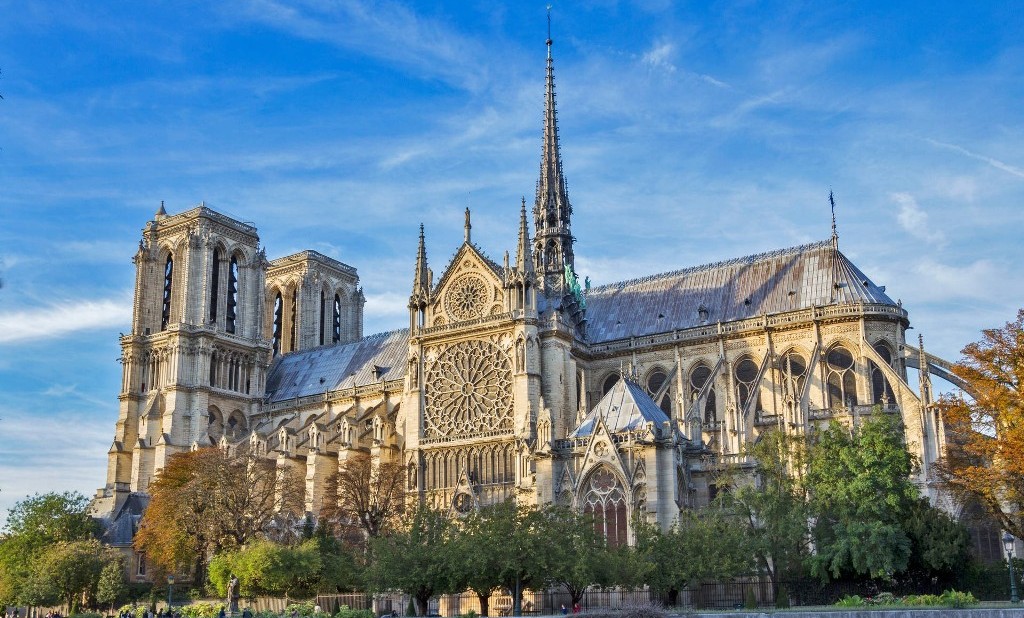
Chatedral Notre Dame
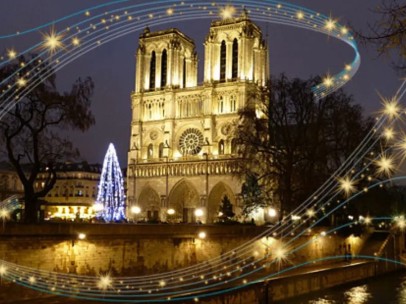 Notre Dame, cathedral of Notre Dame (Our Lady), on the island called Île de la Cité at the heart of Paris. Notable for its elegant proportions, it was a model for the French Gothic cathedrals of the Middle Ages. An earlier church (perhaps preceded by a Roman temple) probably existed on the site of the present building, which was begun in 1163 by Bishop Maurice de Sully and completed, for the most part, by 1250. The original plan was later compromised by the construction (late 13th and early 14th centuries) of a run of side chapels completely encircling the nave and choir.
The west front of the cathedral is a classic of French Gothic style, with three richly carved portals, or doorways. The central portal depicts the biblical story of the Last Judgment. The north and south transept fronts, which date from the second half of the 13th century, are decorated with two rose windows, circular stained-glass windows constructed using a technique called bar tracery, an elaborate stone support system. Another rose window, at the west front of the cathedral, is considered a masterpiece of Gothic engineering for its large glass surface area, which is supported by a seemingly delicate web of carved stone tracery.
The cathedral's interior, 35 m (115 ft) tall, has lost most of its medieval glass, as well as its original fittings (largely removed during liturgical reordering’s in the 18th century). Vandalized during the French Revolution (1789-1799), the building was restored by French architect Eugène Emmanuel Viollet-le-Duc during the 19th century: The tall spire over the crossing is his work. French Emperor Napoleon Bonaparte and the Empress Josephine were crowned at Notre Dame in 1804.
The history of the Cathedral is closely linked to the history of France. Built in the 12th century, modified in the 18th century, and restored in the 19th century, it is the symbol of Christian worship in Paris through the centuries.
In the 4th century, with the advent of Clovis, Paris became the Christian “capital” of the Frankish kingdom. It was then that a first cathedral, Saint-Étienne, was built in the 6th century. The city’s growth began in the 12th century after the Norman invasions. The city prospered, becoming a place of artistic and intellectual exchange, with colleges and a university of philosophy and theology. This marks the beginning of the history of Notre-Dame.
At the same time, the crusades to Jerusalem and pilgrimages to Santiago de Compostela moved thousands of faithful along the roads. The Île de la Cité was a crucial crossing point over the Seine. Consequently, the faithful flocked to the Cité district. They generated commercial activity and offerings for worship. In this context, Maurice de Sully, Bishop of Paris, undertook the construction of a new and vast cathedral to accommodate the faithful. In the 13th century, the population of Paris doubled.
Saint Louis brought back the relics of Christ´s Passion from Jerusalem. They arrived in Paris in 1239, where the king carried them in procession to Notre-Dame. These relics were later kept in the Sainte-Chapelle until the Revolution and joined the treasury of Notre-Dame in 1806.
The cathedral expanded and changed to become a model of religious architecture. During the Renaissance, tastes evolved, and its appeal waned. In the 17th century, through the vow of Louis XIII, the kingdom was placed under the protection of the Virgin and promised a new high altar for the cathedral, which was realized by his son, Louis XIV. Significant renovations took place in the 18th century. Damaged by weather and the Revolution, the cathedral threatened to collapse in the 19th century. Boosted by a resurgence of popularity thanks to Victor Hugo’s “The Hunchback of Notre-Dame,” the state decided on restoration work in the 19th century. Classified as a UNESCO World Heritage Site in 1991, the cathedral was a major centre of Christian worship and the most visited monument in France in 2018.
Following the fire on April 15, 2019, which destroyed the medieval framework and the spire of the cathedral, a major restoration project was made to reopen it for worship and visitors on December 8, 2024.
Microsoft ® Encarta ® 2009. © 1993-2008 Microsoft Corporation. All rights reserved.